 Labelly
Legal Meaning of Common Nutrition and Health Claims
Understanding the defined meanings of food label claims such as low fat, light, reduced sugar, and source of fibre.
Why Claims Have Legal Definitions
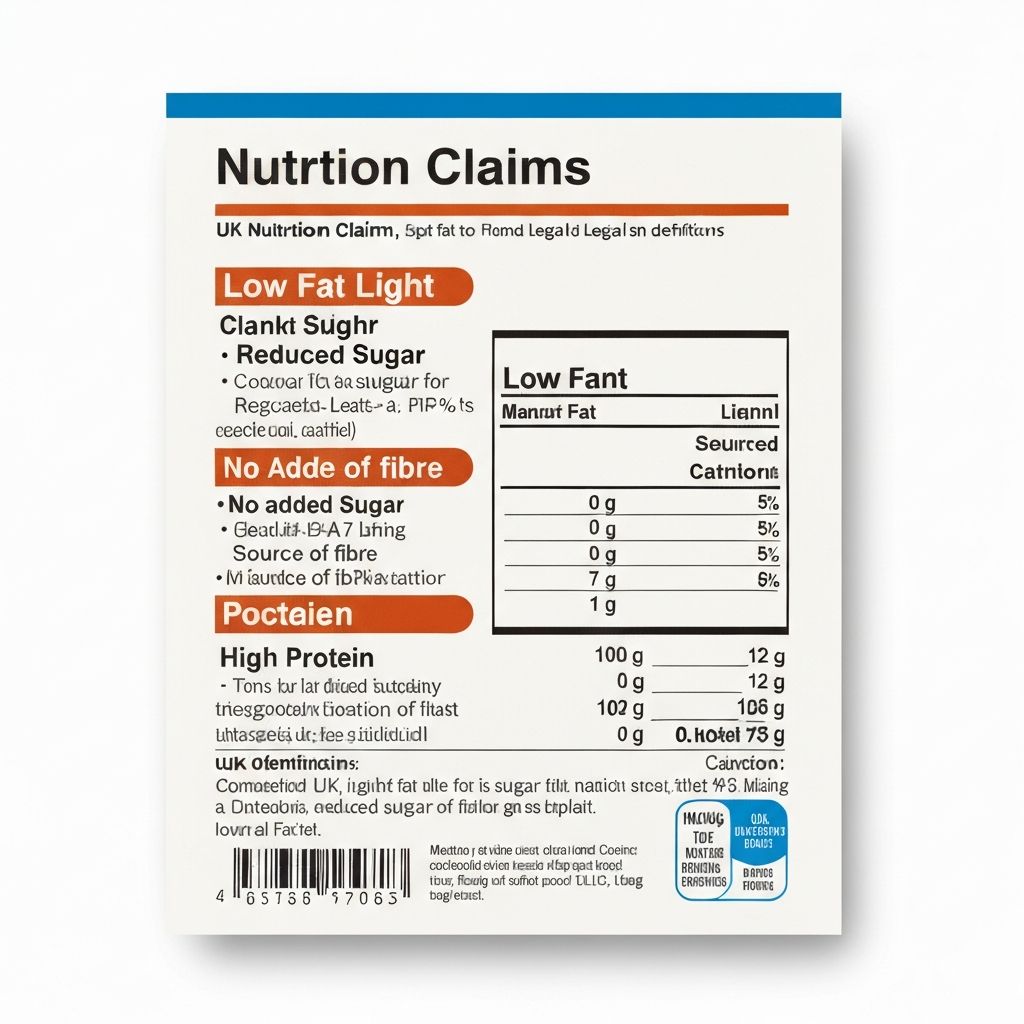
Food label claims such as low fat, light, reduced sugar, and source of fibre are not used casually or arbitrarily. These claims have specific, legally defined meanings established in UK and EU food labelling regulations. The standardised definitions ensure that "low fat" means the same thing on all products from all manufacturers. This consistency allows consumers to compare products reliably and prevents misleading marketing language.
Comparative Claims: Reduced and Light
Reduced Claim
A claim that a product contains less of a specific nutrient than a comparable product. The nutrient must be reduced by at least 25 percent compared to a reference product. For example, "reduced fat" means the product contains at least 25 percent less fat than the standard version of the same product. The reference product must be clearly identified on the label.
Light or Lite Claim
A claim that a product has at least 30 percent less energy content or at least 30 percent less of a specific nutrient than a comparable product. For example, "light in fat" means at least 30 percent less fat than a reference product. The term "light" can refer to energy content, fat content, or other nutrients. The basis must be clear on the label.
Absolute Claims: Low and No Added
Low Fat Claim
A product may claim low fat if it contains no more than 3 grams of fat per 100 grams (or 1.5 grams per 100 millilitres for liquids). This is an absolute definition, not dependent on comparison to another product. The product must actually meet this threshold to use the claim.
No Added Sugar Claim
No added sugar means the product contains no sugars or sugar-containing ingredients added during manufacturing. However, the product may contain naturally occurring sugars or sugar alcohols. A product with naturally high sugar content (such as fruit juice) cannot claim no added sugar if additional sugars are not added, as the sugar is naturally present.
Sugar Free Claim
Sugar free generally means the product contains no more than 0.5 grams of sugars per 100 grams or per serving. The product must meet this threshold. Products using artificial sweeteners can claim sugar free as long as sugars are below this limit. Sugar free products may contain sugar alcohols or other sweetening ingredients.
Source Claims and High Claims
Source of Fibre Claim
A product can claim to be a source of fibre if it contains at least 3 grams of fibre per 100 grams, or at least 2.4 grams per 100 kilocalories. This claim indicates the product provides a meaningful amount of fibre but not necessarily a high amount.
High Fibre Claim
A high fibre claim requires the product to contain at least 6 grams of fibre per 100 grams, or at least 4.8 grams per 100 kilocalories. This is double the threshold for source of fibre, indicating the product is particularly rich in fibre.
Protein-Related Claims
Source of Protein Claim
A product is a source of protein if protein provides at least 12 percent of the product's energy content. This indicates the product contains a reasonable amount of protein for the energy it provides.
High Protein Claim
A high protein claim requires protein to provide at least 20 percent of the product's energy content. This indicates the product is particularly protein-rich relative to its energy content.
Other Common Claims
Low Sodium or Low Salt Claim
A product can claim low salt if it contains no more than 0.3 grams of salt per 100 grams. This is an absolute claim, not dependent on comparison.
Unsalted or No Salt Added Claim
This means no salt has been added during manufacturing, though the product may naturally contain sodium. Unlike low salt, which specifies actual sodium content, unsalted indicates absence of addition during processing.
Consistency Across All Manufacturers
These legally defined meanings apply consistently to all manufacturers. When a manufacturer in the UK claims low fat, it must meet the same definition as every other low fat product. This standardisation prevents misleading marketing and enables fair product comparison. Regulations are enforced by food standards authorities.
Claims Cannot Be Made Without Supporting Evidence
Manufacturers cannot make label claims without ensuring the product meets the claim definition. If a claim is made, the product must be tested or calculated to verify it meets the defined threshold. Claims that are not supported by product composition constitute false labelling and are subject to enforcement action.
Explore other labelling concepts
Discover additional detailed guides about UK food labelling systems and nutrition information presentation.
View all labelling explorations →